FBHP Prediction
Machine-learning models that estimate flowing bottom-hole pressure from routine surface and production data, so you can follow well performance without running more downhole gauges.
Why it matters
Flowing bottom-hole pressure (FBHP) sits at the centre of well performance analysis, inflow performance, artificial lift design and reservoir surveillance.
But permanent downhole gauges are costly to install and maintain, can fail in harsh conditions, and many wells, especially older or marginal ones, have none at all. Empirical correlations and multiphase-flow models help, but they need careful tuning and can drift as well conditions change.
How Encyrex helps
We train machine-learning models on wells where bottom-hole pressure has been measured. The models learn how FBHP relates to everyday surface measurements such as wellhead pressure and temperature, flow rates, gas–oil ratio, water cut, choke size and well geometry.
Once validated, the model estimates FBHP where gauges are missing, have failed, or are being phased out, and gives you a way to cross-check gauges that are still running.
In our peer-reviewed research presented at the SPE Nigeria Annual Conference (2025), our models reported R² above 0.9999. Accuracy on a new field depends on the quality and range of its data, which we assess in the scoped study before making any commitment.
 Interactive prototype
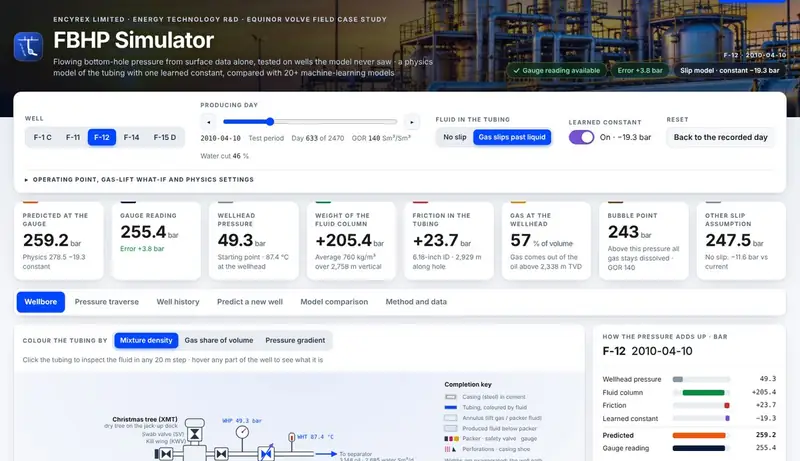
FBHP Simulator
Our FBHP Simulator estimates flowing bottom-hole pressure from surface measurements alone, using public data from Equinor's Volve field in the North Sea. A physics model walks down the tubing in 20 m steps, adding the weight of the oil, gas and water column and friction, with one learned constant that corrects a bias seen in every well.
Pick a well and a producing day, compare the prediction with the gauge reading, test it on wells it never saw, run gas-lift what-ifs, and compare it with more than 20 machine-learning models.
- Data: Equinor Volve field production and well data (Equinor Open Data Licence)
- Physics: Standing PVT, Papay Z-factor, Zuber–Findlay drift flux, Swamee–Jain friction
- Explore: wellbore view, pressure traverse, well history, new-well prediction, model comparison
From your data to a validated result.
Data review
We audit your gauge, production and well data, and flag gaps, outliers and periods to exclude.
Model training
We engineer features from surface and well data and train candidate models against measured pressure.
Blind validation
We test on wells and time periods the model has never seen, and compare against standard correlations.
Deployment
We deliver the model and results in the format your team uses, with a plan for retraining as conditions change.
What we work from
- Wellhead pressure and temperature
- Oil, gas and water rates
- Gas–oil ratio and water cut
- Choke size, tubing and completion details
- Historical downhole gauge or well-test pressures for training
What you receive
- A validated FBHP model with an accuracy report
- FBHP estimates for wells without working gauges
- A cross-check that flags drifting or failing gauges
- Documentation and handover to your engineers
Typical applications.
Wells without gauges
Estimate FBHP where no downhole gauge was ever installed.
Back-up for failed gauges
Keep surveillance going when a gauge fails or drifts.
Artificial lift
Support gas-lift and ESP optimization with continuous pressure estimates.
Productivity monitoring
Track inflow performance and spot declining wells earlier.