Gas Sweetening Optimization
Fast, validated models of amine gas sweetening units that find the operating point with the lowest reboiler energy while keeping treated gas on CO₂ specification.
Why it matters
Amine units remove CO₂ and H₂S from natural gas before it can be sold or liquefied. The regenerator reboiler is one of the largest energy users in a gas plant.
Operators often run extra amine circulation and heat as a safety margin against going off-specification. Finding leaner settings by trial on a live plant is slow and risky, and detailed process simulations take too long to explore every combination.
How Encyrex helps
We build fast surrogate models of the unit from designed process-simulation runs (for example in Aspen HYSYS) or from plant data. The models predict treated-gas CO₂ and reboiler duty from the main operating variables, such as lean amine circulation, lean amine temperature and feed gas pressure.
We compare several modelling approaches, including response surface methodology, fuzzy logic and ANFIS (adaptive neuro-fuzzy inference), and test each on runs it never saw. An optimiser then searches for the lowest-energy settings that still meet the specification, and estimates the fuel and CO₂ savings.
Savings on a real plant depend on its design, feed gas and operating constraints, so we confirm them against your unit's own simulation model or data in the scoped study.
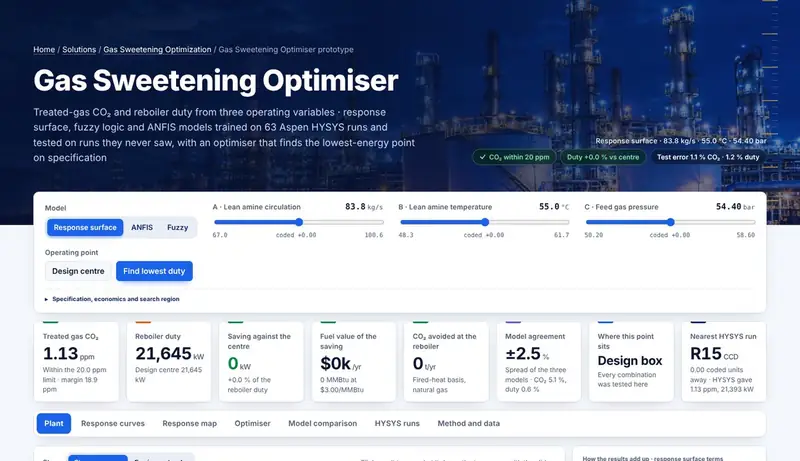 Interactive prototype
Gas Sweetening Optimiser
Our Gas Sweetening Optimiser models an activated-MDEA acid gas removal unit at a Niger Delta LNG plant. Response surface, fuzzy logic and ANFIS models predict treated-gas CO₂ and reboiler duty from three operating variables: lean amine circulation, lean amine temperature and feed gas pressure. They were trained on 63 Aspen HYSYS runs and tested on runs they never saw.
In the model, the optimiser finds settings about 10 % below the design-centre reboiler duty while treated gas stays well inside the 20 ppm CO₂ limit, worth roughly $0.2 million a year in fuel at $3/MMBtu. Move the sliders, explore the response maps and compare the three models.
- Data: Aspen HYSYS simulation of an activated-MDEA unit, MSc research (University of Port Harcourt)
- Design: 20-run central composite design, 40 Latin hypercube runs and 3 check runs
- Explore: plant flowsheet, response curves and maps, optimiser, model comparison, HYSYS runs
From your data to a validated result.
Define the unit
We agree the operating variables, the treated-gas specification and the equipment limits.
Generate data
We run a designed set of simulation cases, or assemble historian data from your plant.
Build and test models
We fit response-surface, fuzzy and ANFIS models and test them on cases they never saw.
Optimise
We find the lowest-energy settings on specification and estimate fuel and CO₂ savings.
What we work from
- A process simulation model of the unit (Aspen HYSYS or similar), or plant historian data
- Feed gas composition, flow, temperature and pressure
- Lean amine circulation rate, temperature and strength
- Treated-gas specification (CO₂ and H₂S limits)
- Reboiler duty, fuel gas price and running hours
What you receive
- Validated models of treated-gas CO₂ and reboiler duty
- A recommended lowest-energy operating window on specification
- Estimated fuel savings and CO₂ avoided
- An interactive what-if tool for your process engineers
Typical applications.
Energy reduction
Cut reboiler duty and the fuel gas that fires it.
Staying on specification
Keep a safe CO₂ margin as feed conditions change.
Operating envelopes
Understand how feed pressure and flow changes move the limits.
Emissions
Reduce CO₂ from fired heat at the reboiler.